Showing posts with label INDIA. Show all posts

Monday, August 27, 2012

A K Hangal, Bal Thackeray & Syed Talat Hussain.


Jingoism: Jingoism is extreme patriotism in the form of aggressive foreign policy. In practice, it is a country's advocation of the use of threats or actual force against other countries in order to safeguard what it perceives as its national interests. Colloquially, it refers to excessive bias in judging one's own country as superior to others – an extreme type of nationalism. The term originated in Britain, expressing a pugnacious attitude towards Russia in the 1870s. "Jingoism" did not enter the American vernacular until near the end of the 19th century. This nationalistic belligerence was intensified by the sinking of the battleship USS Maine in Havana harbour that led to the Spanish-American War of 1898. Wikipedia http://en.wikipedia.org/wiki/Jingoism


Fascism: is a radical authoritarian nationalist political ideology. Fascists seek elevation of their nation based on commitment to an organic national community where its individuals are united together as one people in national identity. They are united by suprapersonal connections of ancestry and culture through a totalitarian state that seeks the mass mobilization of a nation through discipline, indoctrination, physical training, and eugenics. Fascism seeks to eradicate perceived foreign influences that are deemed to be causing degeneration of the nation or of not fitting into the national culture. Fascism was founded during World War I by Italian national syndicalists who combined left-wing and right-wing political views. Fascists have commonly opposed having a firm association with any section of the left-right spectrum, considering it inadequate to describe their beliefs, though fascism's goal to promote the rule of people deemed innately superior while seeking to purge society of people deemed innately inferior is identified as a prominent far-right theme. Wikipedia http://en.wikipedia.org/wiki/Fascism


Artists, Intellectuals, Scholars, Authors are universal, they have no boundaries, they are watched, read, quoted, and consulted respectively without any passport and immigration but Talat Hussain (a property of Hameed Haroon and Amber Saigol and Dawn News) think otherwise recently when Giant Pakistani Artist Mehdi Hasan passed away people of India expressed deep sorrow and grief without bothering about Partition, his nationality, colour, religion, passport, or any other divide and duly honoured Great Mehdi Hasan with Respect and Good words, Talat Hussain, Hameed Haroon and Amber Saigol's Alleged Honour was sleeping somewhere when Indians were praising Mehdi Hasan but suddenly "The Sick Patriotism" comes alive in Talat Hussain, Hameed Haroon, Amber Saigol and Dawn News when Pakistanis reciprocated the same honour to a recently departed Indian Artist Rajesh Khanna. Talat Hussain and Dawn News vomited venom in an already venomous atmosphere without bothering about the fact that Mehdi Hasan was born on that side of Border which is now India (in Rajasthan) and Rajesh Khanna had his roots in Burewala, Punjab, Pakistan, A K Hangal born in Sialkot (Punjab) and now both sides are two different countries courtesy alleged Founding Fathers and Alleged Freedom Fighters of now Both sides. By the way A K Hangal lived early part of his life in Sialkot, Peshawar, and Karachi. Now Talat Hussain and no good Hameed Haroon and Dawn News should start Tabbarra on Sialkot, Peshawar, and Karachi. Tribute to Rajesh Khanna (1942 to 2012) Part - 1 http://amughal.blogspot.com/2012/08/tribute-to-rajesh-khanna-1942-to-2012.html Tribute to Rajesh Khanna (1942 to 2012) Part - 2 http://amughal.blogspot.com/2012/08/tribute-to-rajesh-khanna-1942-to-2012_15.html Tribute to Ghazal Maestro Mehdi Hasan by Alauddin Khanzada & Asif Noorani. http://chagataikhan.blogspot.com/2010/12/tribute-to-ghazal-maestro-mehdi-hasan.html Tribute to Ghazal Maestro Mehdi Hasan by Alauddin Khanzada & Asif Noorani http://amughal.blogspot.com/2010/12/tribute-to-ghazal-maestro-mehdi-hasan.html


Down Memory Lane With A K Hangal


http://www.youtube.com/watch?v=a9nNwjdGbsg


A K Hangal with Comrade Sobho Gianchandani Honouring Sajjad Zaheer: NEW DELHI: India’s distinguished movie actor and communist ideologue A.K. Hangal died in a Mumbai hospital on Sunday following a brief illness, Press Trust of India said. It said his son Vijay Hangal, a retired still cameraman in Bollywood, appealed for help after failing to meet Hangal’s medical expenses. Several Bollywood celebrities like the Bachchans, producer-director Vipul Shah, and actors Mithun Chakraborty, Aamir Khan and Salman Khan came forward to help him. The 95-year-old character actor and veteran of the fabled progressive cultural troupe, the Indian Peoples’ Theatre Association (IPTA), passed away at 9am at the Asha Parekh Hospital in suburban Santacruz in Mumbai, where he was admitted on Aug 16 after fracturing his thigh bone. Best known for his one-liner from blockbuster Sholay — Itna sannaata kyun hai bhai (why so much silence is there), Hangal entered Bombay cinema when he was in his 40s and went on to act in over 200 films. He endeared himself to the audience by playing the role of the lovable old man in films like Sholay, Shaukeen and Namak Haram, “This is really a sad thing…now I am left all alone. I have no words to describe his loss,” Vijay Hangal told PTI. “He was a strong man…he has been a great support to me,” he said. Avtaar Veenit Kishan Hangal was born in a Kashmiri Pandit family in Sialkot and came to the city of dreams — then known as Bombay — at the age of 21. PT said he made an impressive mark as the old man who gets up and joins the troupe in the song Ghanan Ghanan, where he sang one line Kale Megha Kale Megha Pani To Barsao in Aamir Khan-starrer Lagaan. The actor was honoured with the Padma Bhushan for his contribution to Hindi cinema in 2006, was in the news last year for living a life in penury. Recently, he returned to face the studio lights after several years for TV series Madhubala, PTI said. REFERENCE: Legendary Indian actor Hangal dies in penury http://dawn.com/2012/08/27/legendary-indian-actor-hangal-dies-in-penury/ Veteran Indian actor A.K. Hangal dies at 95 http://dawn.com/2012/08/26/veteran-indian-actor-a-k-hangal-dies-at-95/


A K Hangal left alone


http://www.youtube.com/watch?v=JvWje5jR0o8


AK Hangal dies at 97, bigwigs skip funeral : Not a single big name from the film industry turned up for the cremation of veteran character actor A K Hangal on Sunday. The 97-year-old, a veteran of over 225 films, passed away early in the morning at Asha Parekh hospital in Vile Parle following a brief illness aggravated by a fracture of his thigh bone. Only character actors like Rakesh Bedi and Raza Murad and friends like Ila Arun were present for the last rites. But that didn't really matter to a man who had dedicated his life to theatre, cinema and social issues. Some theatre enthusiasts posted comments on social networking sites. One of these said that another acting academy had shut down. Hangal was one of the most endearing old men of the film industry with roles in Sholay, Namak Haram and Shaukeen. His one-liner from Sholay, 'Itna sannata kyon hain bhai', achieved cult status.


Sholay's Rahim Chacha had to depend on Bollywood for aid to fight illness. But the actor, who swore by leftist philosophy, believed that the state needs to accept the responsibilities of senior citizens. His son Vijay said, "My father was highly spirited and fought till the end. He survived even after life support was taken off." He added, "He even shot a small scene for the TV serial Madhubala despite his poor health. The moment the camera was switched on, his energy came back.'' Fashion designer Riyaz Gangji, who would visit the actor almost every day, said, "When I asked him if he wanted life support back, he said no.'' Hangal had walked the ramp for the designer last year. Murad said, "The actors would've come if a political party summoned them. But they didn't have an hour to spare to pay their last respects to the man who gave 50 years to the industry and worked with all top stars.'' Hangal started his film career rather late. The actor, who participated in the freedom movement, started off as a tailor. He got associated with actors like Balraj Sahni, Sardar Jafri and Kaifi Azmi, who persuaded him to act. He entered the film industry at the age of 50 with Basu Bhattacharya's Teesri Kasam.


Though new to the industry, he was not afraid to express his anger over Raj Kapoor walking onto the set late. Hangal was very vocal about his political views. He had faced a ban on his film career after the Shiv Sena objected to his attending a function organized by the Pakistan consulate in Mumbai in the 1990s. A Communist Party of India member, Hangal continued to renew his membership every year. Hangal acted in over 225 films in his film career spanning over four decades. He played the roles of a father, uncle or housekeeper to many a big star, including Jaya Bachchan, Sanjeev Kumar, Rajesh Khanna and Amitabh Bachchan. He had cut down on acting for 10 years, but did small roles in Aamir Khan's Lagaan and Shah Rukh Khan's Paheli. The actor's financial condition became an issue with his health falling and his son Vijay having to stop work to look after his father. After reports about Hangal's poor financial condition, the information and broadcasting ministry announced a plan for health insurance of retired actors which has not yet materialized. Vijay said, "The industry's aid did help us pull through all his medical needs. Though film industry bigwigs were not there, his friends from IPTA and character actors attended the cremation. We are planning a condolence meeting at Prithvi Theatre at 4pm on Monday.'' AK Hangal dies at 97, bigwigs skip funeral TNN | Aug 27, 2012, 05.53AM IST http://timesofindia.indiatimes.com/entertainment/bollywood/news-interviews/AK-Hangal-dies-at-97-bigwigs-skip-funeral/articleshow/15795100.cms


Bollywood Comes finally for A K Hangal


http://www.youtube.com/watch?v=w93vy1Vf9_A


AK Hangal: Bal Thackeray once called him a traitor Hangal was drawn to Indian People's Theatre Association (IPTA) in India. He started working with Balraj Sahni and Kaifi Azmi in IPTA. In his late 40s, Hangal was offered the part of Raj Kapoor's brother in 1966 film "Teesri Kasam" by director Basu Bhattacharya but his scenes were removed from the film. There was no looking back for him after that. He starred in over 200 films. His mostly played roles of father, uncle, grandfather or that of a meek and harassed old man, an image he could never get rid off. The veteran actor suffered a political backlash in 1993 when he applied for visa to visit his birthplace in Pakistan. He was invited and attended the Pakistan day celebrations by the consulate in Mumbai thereby incurring the wrath of the Shiv Sena. Shiv Sena Supremo Bal Thackeray took offence and called him a traitor. A call to boycott his films was made, his effigies were burnt and his scenes were deleted from films. He bounced back after two years with character roles in Amitabh Bachchan's home production "Tere Mere Sapne" and Aamir Khan's "Lagaan". He last shot for Shah Rukh Khan starrer "Paheli" in 2005.


He was awarded Padma Bhushan for his contribution to Hindi cinema in 2006.


The actor was in news last year for living a life in penury. His son Vijay, a retired still cameraman in Bollywood, appealed for help after failing to meet Hangal's medical expenses. Several Bollywood celebrities like the Bachchans, producer-director Vipul Shah, and actors Mithun Chakraborty, Aamir Khan and Salman Khan came forward to help him. He returned to face the studio lights again recently after a gap of seven years for TV show 'Madhubala'. Having reached the sets on wheelchair, Hangal was not sure if he would be able to handle it physically. But he came in his elements once the cameras started rolling. He has a 74-year-old son Vijay with late wife Manorama. REFERENCE: AK Hangal: Bal Thackeray once called him a traitor PTI Aug 26, 2012, 11.05AM IST http://articles.timesofindia.indiatimes.com/2012-08-26/news-interviews/33402013_1_bal-thackeray-tv-show-madhubala-mithun-chakraborty

Wednesday, August 15, 2012

Tribute to Rajesh Khanna (1942 to 2012) Part - 2

NEW DELHI, July 18: He carried his fame lightly. He was a stout-hearted Punjabi from Amritsar who probably forgot to take care of his liver and perished at 69 to its seductions. Women flirted with his images for all of the two decades or more when he ruled Mumbai’s film industry as India’s first and possibly only superstar. Female fans worshipped his framed pictures and slit their wrists when he married Dimple Kapadia, a one-movie starlet in 1973, when she was half his age. Rajiv Gandhi, in his last political duty before flying to his death in Tamil Nadu, came to vote for him when he switched from films to politics in the 1991 parliamentary elections. Rajesh Khanna was narrowly defeated in that election from New Delhi by opposition leader L.K. Advani. But when Advani quit the seat in favour of his election from Gandhinagar in Gujarat, Rajesh Khanna easily beat rival and fellow actor Shatrughan Sinha in the ensuing contest to enter parliament. He had replaced Amitabh Bachchan as the Gandhi family’s Mumbai mascot. Naturally, Sonia Gandhi grieved Rajesh Khanna’s death in Mumbai on Wednesday and so did Prime Minister Manmohan Singh among millions of Indians. In Pakistan, special programmes were broadcast by TV channels to mark the passing of an era. Prime Minister Raja Pervez Ashraf described him as a “great actor”. Ordinary fans from across the border took to social networking websites to share their sorrow and memories. In a special message, Prime Minister Ashraf said Khanna was “a great actor whose contribution to the field of films and arts would be long remembered”. REFERENCE: In death, Rajesh Khanna unites India, Pakistan Jawed Naqvi | 19th July, 2012 http://dawn.com/2012/07/19/in-death-rajesh-khanna-unites-india-pakistan/

Rajesh Khanna - Bombay Superstar - 5 of 9


http://www.youtube.com/watch?v=Dpw2qZgZzO0


He said Khanna had a “large fan following across the borders and captivated audiences with his excellent acting skills”. He said he shared the grief of the bereaved family. In a message to Khanna’s daughter Twinkle, Prime Minister Singh recalled the fame of the late actor and noted that his popularity as a romantic hero in the 1960s and 1970s is a part of our film folklore. Observing that Khanna was a celebrated artiste who entertained millions of Indians with his performance in a variety of films, Dr Singh said: “His legacy will live on in the form of the numerous entertaining and acclaimed films that he leaves behind.” The prime minister noted that the late actor was called the first superstar of the Indian cinema and the powerful roles he essayed in classics like Anand, Aradhana, Kati Patang and Amar Prem stand testimony to his artistic genius. Some years ago, the new reigning movie star Shahrukh Khan had described Rajesh Khanna as the only superstar the Indian film industry ever had. REFERENCE: In death, Rajesh Khanna unites India, Pakistan Jawed Naqvi | 19th July, 2012 http://dawn.com/2012/07/19/in-death-rajesh-khanna-unites-india-pakistan/

Rajesh Khanna - Bombay Superstar - 6 of 9


http://www.youtube.com/watch?v=CJgOU7djrt8


Bollywood superstar Rajesh Khanna, who passed away last week after a prolonged illness, was the first actor to give 15 super-hit flicks in three years.
As the winner of the United Producers Talent Contest in 1965, Rajesh Khanna had come a long way. He was a not overtly handsome, yet ’70s actresses like Waheeda Rehman desired to be cast opposite him. He didn’t have the ideal built of a he-man, yet no other actor has since commanded a female following like him. Above all, he wasn’t even the best actor produced in India, but it was his charisma, a shake of the head and stylish antics that saw him leap over the likes of Dilip Kumar, Raj Kapoor as well as Dev Anand to super stardom. Born as Jatin Arora on December 29, 1942, and adopted by his father’s childless relatives, he was named Rajesh Khanna by his uncle so that he could do well in films. It is even said that after winning the talent contest, he went for auditions in an MG sports car, something unheard of in those days. Financially he was stronger than most of the leading men of his era, even before he landed blockbusters. Several reports from that era suggest that many girls in India married his photograph, applying their own blood as sindoor to solemnise the ceremony. Pampered in his youth and worshipped as an actor, Rajesh had an enviable career. His first movie, Aakhri Khat (1966) did well, but couldn’t rival the success of Shammi Kapoor’s Teesri Manzil or Dharmendra’s Phool Aur Pathar. His next few films — Raaz, Baharon Kay Sapne and Aurat — didn’t do well at the box office either. However, Aradhana (1969) started a chain reaction that saw him deliver hits after hits, including the songless Ittefaq and commercial flicks like Bandhan, Do Raaste, Khamoshi, The Train, Succha Jhoota, Safar, Kati Patang, Anand and Haathi Mere Saathi. He also gave screenwriters Salim-Javed (who later delivered hits like Sholay, Kaala Pathar and Shakti) their first break in Haathi Mere Saathi. Even Amitabh Bachchan admits that before he became an actor, he was a Rajesh Khanna fan. Rajesh Khanna adjusted comfortably into any role offered to him — be it the sculptor in his debut movie Aakhri Khat, the air force pilot in Aradhna, the cancer patient in Anand, the forest office in Kati Patang, the cook in Bawarchi or the working class hero of Namak Haram. Rajesh Khanna’s popularity suffered declined in the latter part of his career by way with his typical acting and inability to improvise in the films of the ’80s and beyond. — O.A. REFERENCE: Final farewell 29th July, 2012 http://dawn.com/2012/07/29/final-farewell/

Rajesh Khanna - Bombay Superstar - 7 of 9


Located on the old road from Multan to Delhi, the town of Burewala in Vehari district in southern Punjab was once known primarily for the shrine of Hazrat Baba Haji Sher Dewan. Irrigated by the Pakpattan Canal during the British Raj, it became part of the fertile agricultural lands known as the Canal Colonies. It must have been a very small place, a kind of a qasba in the years leading up to partition. Since then, the productivity of land and the galloping population increase, have contributed to this once small town becoming fairly big even by Pakistani standards (its population was about 1,89,000 in 2006). It was in these environs that Rajesh Khanna was born in Burewala in 1942. His father Lala Hira Nand Khanna was the first headmaster of MC Model Boys High School there -- from April 1, 1931 until retiring on March 28, 1947, months before Partition. The headmaster must have struggled to instil the virtues of education to people more thrilled by the force of numbers and fascinated by shortcuts to wealth and fame. A board at the school still bears his name. Rajesh Khanna studied till Class 1 in the local primary school. His ancestral home, a two-storey structure with arched windows, still stands in Block H of Burewala. The name "Jatin Niwas" is still visible, inscribed in Hindi at the main gate of the family house, to which the current residents have made few changes. Next to it is an old temple. As Khanna's last rites began in Mumbai, Burewala residents gathered at MC Model High School to hold a condolence meeting, including a five-minute silence. REFERENCE: Rajesh Khanna of Burewala By Sarwat Ali Wednesday, July 25, 2012 http://www.thenews.com.pk/Todays-News-14-122643-Rajesh-Khanna-of-Burewala

Rajesh Khanna - Bombay Superstar - 8 of 9


http://www.youtube.com/watch?v=MyOnlfuXcIU


The family migrated along with millions after Partition to settle in Amritsar, the first urban settlement after crossing the lines drawn by Radcliffe. It was here that the young Rajesh Khanna must have gone to school and nurtured his dream of becoming a filmstar. The kind of fame and accolades that he drew must have been beyond his own imagination or expectations. From his first lovely debut with Akhri Khat to his first real box office hit Aradhana he must have struggled for a firm foothold in an industry that was planning a makeover into the third generation of films after independence, if Dilip Kumar represented the first generation and Shammi Kapoor the second. But in Aradhana, Sharmila Tagore and the compositions of S.D. Burman ushered in a new era not shy of tackling issues that the new educated middle classes in the cities were being confronted with. Still locked in the conflict of the traditional values with the demands of modernity, the first popular expression on the side of modernity came in the form of the films being made in the late nineteen sixties. Since Partition, Burewala has been famous for the textile industry. The town subsequently shot into limelight with the emergence of Waqar Younis, the fast bowler from the same town. Along with Wasim Akram, he struck terror in the heart of batsmen; the two dreaded Ws ran through many a batting line-up including the Indians. http://www.thenews.com.pk/Todays-News-14-122643-Rajesh-Khanna-of-Burewala

Rajesh Khanna - Bombay Superstar - 9 of 9

http://www.youtube.com/watch?v=LlrN4Sj5zZM


Cricketers and filmstars are popular across the divide. Pakistani fast bowlers, in particular, are the heartthrobs of fans on both sides and admired by connoisseurs of the game. Even when Indian films were totally banned in Pakistan, with no Amritsar television or video cassette recorders (VCRs) to provide a sneak peek, Pakistanis talked about Indian films and gossiped about the doings and misdoings of Bollywood stars. During that time, LPs and 78 rpm discs made music available to those who could afford such luxuries. Radio in India was one medium that broadcast Indian film music followed by avid listeners all over Pakistan. It can be said with great deal of certainty that the people in Pakistan lapped up whatever happened in Bombay, and to a lesser degree in Calcutta or Madras. Similarly, listeners across the border listened very critically to the songs of Noor Jehan and Mehdi Hasan. In fact, it was on radio that Lata Mangeshkar first heard Mehdi Hasan sing, and she could not help paying him the highest compliments.

The Khannas, a sub-section of the well-established Khatri clan of the Punjab, were active in many fields. They also lived in Lahore and were famous for their contribution to the field of education. Some had converted to Christianity and stayed back after Partition to continue doing what they could do best.

With Amritsar Television and then the advent of the VCR, Rajesh Khanna became the heartthrob of many women. They loved his cheekiness, his bold wooing and carefree mannerisms; with tearful eyes they sighed with him as he staggered seeking solace in the arms of Sharmila Tagore in Amar Prem. He was the innocent man, harmed as he went seeking love, often unsuccessfully. Men and women alike admired him for playing roles in films that did not fit into the boy-meet-girl sing and dance format, like his film Anand.

The late sixties and seventies saw the prime of Rajesh Khanna, as he made many a film which did well at the box office only because of his presence. This was also the time when Indian cinema made a comeback into the lives of Pakistanis, who till then had been forced to rely only on the written and spoken word. He symbolised the era in which people in Pakistan who had seen the films of Dilip Kumar, Raj Kapoor and Dev Anand were reunited with productions emanating from the sub-continent's cinema capital. Looking back, we see that so many from the areas that are now in Pakistan headed towards Bombay; some stayed there. Rajesh Khanna also took this path via Amritsar because his family had moved there in after partition. http://www.thenews.com.pk/Todays-News-14-122643-Rajesh-Khanna-of-Burewala

Tribute to Rajesh Khanna (1942 to 2012) Part - 1

MUMBAI: Rajesh Khanna, often referred to as the “first superstar” of Bollywood and the Hindi film industry’s biggest heart-throb in his day, died on Wednesday after months of being unwell. He was 69. Khanna, who had been sick since April with an undisclosed illness rumoured to be cancer, passed away at his family home in Mumbai after being discharged from hospital on Tuesday, reports said. Indian Prime Minister Manmohan Singh led an outpouring of grief on Twitter where fans reminisced over his greatest movies and wished his wife and two daughters well. “I convey my heartfelt condolences to the members of the bereaved family and countless fans and admirers of Shri Rajesh Khanna,” said Singh’s official Twitter feed. Known as “Kaka” (uncle) to his fans, Khanna was not from an acting dynasty like many big Bollywood names. He was born in the city of Amritsar in the northwest of India in 1942 and enjoyed being on stage from his school days. He made his film debut in “Aakhri Khat” (The Last Letter) in 1966 but his big break came with runaway hit “Aaradhna” (Worship) three years later, followed by a string of successes, with Khanna typically as the romantic lead. His prominent hits of the 1970s included “Kati Patang” (Broken Kite), “Anand” (Happiness) and “Amar Prem” (Everlasting Love). In total he appeared in more than 150 Hindi films. REFERENCE: Rajesh Khanna dies in Mumbai AFP | 18th July, 2012 http://dawn.com/2012/07/18/rajesh-khanna-dies-in-mumbai/

Rajesh Khanna - Bombay Superstar - 1 of 9


http://www.youtube.com/watch?v=fWmucHoZN3U

Khanna’s entry to the industry came at a time when fans were looking beyond fading stars of Bollywood legends such as Dilip Kumar, Raj Kapoor and Dev Anand. He was soon getting letters written in blood by his female fans and his car was marked with lipstick stains wherever he went. There were even reports of his female admirers marrying his photographs. British broadcaster Jack Pizzey in a 1973 BBC documentary “Bombay Superstar” described Khanna as having the charisma of Italian actor Rudolph Valentino and the arrogance of Napoleon. Many Indian hearts were broken when he married young actress Dimple Kapadia in 1973. They had two daughters and later separated, but she returned to look after him during his final days of illness. REFERENCE: Rajesh Khanna dies in Mumbai AFP | 18th July, 2012 http://dawn.com/2012/07/18/rajesh-khanna-dies-in-mumbai/

Rajesh Khanna - Bombay Superstar - 2 of 9


http://www.youtube.com/watch?v=C3XCYEM7Wc4

Despite his huge success, Khanna’s star was later eclipsed by that of actor Amitabh Bachchan, who emerged in the early 1970s as an anti-establishment hero in roles as an angry young man. Indian audiences began to lose their taste for Khanna-style romances and family dramas, while Bachchan’s roles identified with the frustration of the country’s youth, struggling with a lack of opportunities during a closed economy. Khanna never quite regained his superstar status, although he did make a comeback in 1983 with two hits, including “Avtaar”, a story of a father abandoned by his children. He released another 11 films the following year. REFERENCE: Rajesh Khanna dies in Mumbai AFP | 18th July, 2012 http://dawn.com/2012/07/18/rajesh-khanna-dies-in-mumbai/

Rajesh Khanna - Bombay Superstar - 3 of 9


http://www.youtube.com/watch?v=FO5osyRFz5M

Later in the decade he moved into politics, contesting elections on a Congress Party ticket and becoming a Member of Parliament for New Delhi in the 1990s. His later film roles were largely insignificant, although he shocked fans in 2008 when he did an intimate scene with then-unknown starlet Laila Khan in the film “Wafaa: A Deadly Love Story”. Laila, suspected to have had links with banned terror groups, was killed along with her family members last year. Criticised as too bold for Indian screens, Khanna nevertheless said he was proud of the role. His last frail onscreen appearance was in his first television commercial for electric appliance company Havells. REFERENCE: Rajesh Khanna dies in Mumbai AFP | 18th July, 2012 http://dawn.com/2012/07/18/rajesh-khanna-dies-in-mumbai/

Rajesh Khanna - Bombay Superstar - 4 of 9


http://www.youtube.com/watch?v=X7Yes8lcdOg

What they’re saying on Twitter:


“RIP Rajesh Khanna. The Phenomenon. Thank you for the magic.” – Rahul Bose


“India’s only real Superstar is no more. Rajesh Khanna was and remains ‘The Phenomenon’.” - Shobhaa De


“Rajesh Khanna gave us a crash course in Romance. He introduced us to a special twinkle in the eye that made us feel good about ourselves. RIP” - Anupam Kher


“When we lose a loved one, something within us dies. Our generation loved Rajesh Khanna. Today a bit if us dies with this enigmatic star.” - Mahesh Bhatt


“Just heard the saddest news. The 1st Superstar of India is no more. But the legend that was Rajesh Khanna will live eternally through his films.” - Farah Khan

Monday, April 23, 2012

Punjabi Folk Maestros: Jagmohan Kaur & K Deep.


A husband and wife team, who specialized in mixing comedy and slightly risqué comedy at that with music, as their variety shows became so popular not in India but all over the world also. K. Deep was the king and Jagmohan Kaur was his queen. Popular as “king of variety shows”, K. Deep and Jagmohan Kaur came into the limelight as duet singers in the ‘70s. K. Deep was perhaps the first artiste who mixed melody with comedy to make it an effective source of entertainment. His cassettes “Mai Mohno” was not only a hit in the ‘80s, but continues to be in demand even today. Jagmohan Kaur, the erstwhile ‘‘koel’’ of Punjab, was popular with her songs and captivating histrionics as “Mai Mohono”, with her husbansd K. Deep acting as “Posti”. K. DEEP is indeed a versatile Punjabi artiste. He had stopped his stage performances after the death of his stage and life partner Jagmohan Kaur about nine years ago. His entry into the world of stage was dramatic. After doing a diploma course from Sir Chhottu Ram Polytechnic Institute in Haryana, K. Deep had come to Chandigarh for an interview in 1970. He got late and in the evening there was some cultural function. He got a chance to perform at the function where a recording team of the HMV was also present. After he came down from the stage, the Director of the HMV impressed by his voice and flair for comedy made him an offer on the spot that he should come to Delhi for recording. He got his first LP recorded in 1970 and there has been no looking back since then.

Jagmohan Kaur - Puran (Lok Gatha)


http://www.youtube.com/watch?v=iyPgtrI8lWM

Traditional Punjabi Bhangra on Dhol by Jagmohan Kaur


http://www.youtube.com/watch?v=S01iCYQe2ms

His meeting with Jagmohan Kaur was also an interesting episode. He had gone to Calcutta on the invitation of a Punjabi society to perform at a cultural programme. Jagmohan Kaur along with several other Giddha artistes was also there. Jagmohan Kaur fell for him when he won the applause of the audience for his earthy comedy laced with a melodious voice. There were some hurdles, but they got married and performed together on stage. This continued till Jagmohan Kaur left for her heavenly abode. Their most popular songs in the ‘80s were Baitha nim thale ni jawai tere baap da..., Paisa hai nahi pale, guttar vangu jhakda..., Baba ve kala marore..., Meri gal sunno Sardarji, Tere ni bharava mannu kuttia.., and Bara karara pudna... Apart from stage performances, K. Deep also made several documentaries. He staged variety shows almost in all countries, including the USA, Canada, and the UK where Punjabis are settled in a good number. He was busy in the past few years to make a documentary on Punjabis around the world. Already he has been to 14 countries in this connection. K. Deep who was earlier known as Kuldeep when he was a student at his home village Attiana near Halwara in Ludhiana district. Attiana has given some very famous artistes, including Daljit Kaur, to the Punjabi theatre and film world.

Ni Main Kamli Aan (Bulleh Shah) - Jagmohan Kaur


http://www.youtube.com/watch?v=M3rLfYzRjLw


Ni Main Kamli Aan by Jagmohan Kaur


http://www.youtube.com/watch?v=dEuTd7PLT50

K. Deep is a great imitator. He can imitate any one. His voice culture is very impressive. His unmatched quality is that he can play any sort of music with his mouth without using any musical instrument. He is also an actor and has done theatre. Known as a shy boy at the school level, K. Deep has emerged as an artiste full of wit, comedy and melody. Mr K. Deep also want to make Aab-e-Hayyat a vibrant cultural centre with the help of the Punjabi Sabhyachar Akademi. Now Both K. Deep and his daughter, Gurpreet, ‘‘Billy’’ to her friends, want to perpetuate the memory of Jagmohan Kaur, an all-time great Punjabi folk singer, who like Shiv Batalvi died young. Up till now they have had numerous successful shows to their credit in North America and other places in the world in memory of her. K. Deep, besides singing, has been in production and direction of documentaries, serials and films. ‘‘Billy’’ wants to be a ‘‘promoter’’. Both K. Deep and "Billy" had settled at Burnaby in British Columbia in Canada. There too, they tried to serve their mother tongue, Punjabi, and folklore of their state of origin. REFERENCE: Ludhiana Personality :: K. Deep & Jagmohan Kaur http://www.ludhianadistrict.com/personality/kdeep_jagmohan_kaur.php


RANI ISHRA DAHAN MAARDI - JAGMOHAN KAUR


http://www.youtube.com/watch?v=3alo0EsYu6s


THE centuries-old Pooran Di Khuee (the well of Pooran) situated at a far-off border village, Karol, in Kotli Syed Ameer sector, remains a ray of hope for the issueless who believe that the Allah Almighty will bless them with children if they take a bath around it every Sunday night in the moonlight of each Islamic month. Dozens of issueless people, therefore, visit Pooran Di Khuee every Sunday night and perform these rituals. Women hang their colourful ‘dopattas’ on the centuries-old tree near the well and the temple of Pooran, hoping that their prayers for children would be granted. Several people told Dawn that Allah Almighty gave them children after they had repeatedly visited Pooran Di Khuee. Before partition, the issueless Sikhs and Hindus used to visit the place to pray for children. Now, couples from all over Pakistan visit it throughout the year for the same purpose. According to Tareekh-i-Sialkot (the history of Sialkot), compiled by historian Rashid Niaz, Pooran was the son of the then ruler of Sialkot, Raja Salbahan. Pooran was very handsome and innocent. Raja Salbahan’s wife Rani Loonan, the daughter of the ruler of Jammu state, was issueless. The Raja felt the need of a son who could inherit his kingdom. So he married a poor and pretty girl, Ichchran. Rani Ichchran became much beloved of Raja Salbahan when she gave birth to a son named Pooran. Raja Salbahan declared Pooran as his successor. On this, Raja Salbahan’s first wife Rani Loonan become jealous of her stepson. Raja Pooran turned a handsome and charming youth full of innocence. His stepmother, one day, under a plan, accused him of trying to criminally assault her. She also misguided Raja Salbahan, terming the innocent boy a vagabond. On this, Raja Salbahan became very angry and without verifying the accusation ordered his lieutenants to throw his only and beloved son into a well (Chah-i-Zindan) after cutting his arms and legs. Pooran was not given a chance to clarify his position.

Tareekh-i-Sialkot revealed that Raja Salbahan’s men threw Pooran into Chah-i-Zindan after cutting his hands and legs. This was what Rani Loonan had wanted. Chah-i-Zindan was located on the banks of the river Chenab. The same day, Sikh saint Guru Gorakhnath, with dozens of his disciples, reached the well. They found Pooran in it and took him out in a critical condition. Later, Pooran told his entire story to the Guru, who adopted him as his disciple. It is said that Pooran regained his legs and arms with the special worship and prayers of his Guru. Pooran started worship of God under his supervision and became a Bhagat preaching the teachings of his Guru. Hearing the fame of Pooran’s miracles, Raja Salbahan and Rani Loonan went to Pooran Bhagat and requested him to pray to God to bless them with a child. Pooran Bhagat introduced himself as Raja Pooran, their son, and proved that he was not guilty as his issueless stepmother, Rani Loonan, out of jealousy had blamed him for trying to rape her. Pooran asked his stepmother to accept her fault if she wanted a child.

Rani Loonan admitted before Raja Salbahan that she had unjustly blamed her stepson who was innocent. Raja Salbahan felt ashamed and asked him to come back and take charge as a new ruler of his kingdom. Refusing to go back, Pooran Bhagat prayed to God to bless them with a child. Later, he gave them the good news that God will give them a handsome boy and his name would be Raja Rasalu. Tareekh-i-Sialkot revealed that Raja Salbahan constructed a temple, Lungar Khana, Ashnan Ghar and Dharam Shala at the place where his son, Pooran Bhagat, had lived and preached. According to another history book, Mutiny in Sialkot, Pooran Bhagat’s Samadhi remained there till 1857. It disappeared with the passage of centuries, leaving behind only a small well Pooran Di Khuee and a small temple there which are being looked after by issueless people, who visit the place. REFERENCE: A ‘ray of hope’ for the issueless February 12, 2003 Wednesday Zul Hijjah 10, 1423 http://archives.dawn.com/2003/02/12/fea.htm#1

Tuesday, April 26, 2011

Folk Music of Manganhar & Banjaras of Tharparkar & Rajasthan.


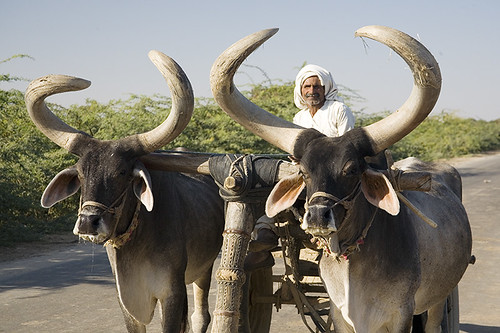
http://www.rajasthanvisit.com/images/Turban.jpgOriginating centuries ago in the Jodhpur and Jaisalmer desert areas of Rajasthan, the Banjaras were bullock transport carriers and builders of great monuments, who ranged throughout the subcontinent negotiating and maintaining expensive contracts to supply goods to important customers as the Moghal armies and the British. For centuries, they efficiently moved their enormous caravans through vast roadless tracts of all India, guarantying safe conduct for grain, salt and messages. Doing so they spread from Kashmir to Tamil Nadu, from Orissa to Gujarat, spilling over into Sind, Pakistan, Iran and further west. Since they wore all their wealth, they were famed for their colorful dress and spectacular jewelry, and known for their lyricism, for song, poetry and dance, and for the maintenance of a unique aesthetic in their embroidery.


http://3.bp.blogspot.com/_U9iti0nqFXk/SsQ0ErUmRVI/AAAAAAAABnA/026hHGiUYzI/S760/banjara+women.jpg

With the advent of the railway and the building of a road system, the Banjaras lost their primary occupation, but retained their tradition of monument buildings. Typical of peripatetic nomads, the Banjaras maintain strong boundaries so that they can interact with surrounding peoples and yet retain their cultural integrity. Such boundaries include the separate villages called tanda where the majority of the Banjaras still live today, situated near large cities where they work as construction laborers, or in remote rural areas where they farm, raise and herd animals. Their religion very different from the mainstream one. Their myths are origin, traditional taboos and social structure. The language they use is known as “ghormati” or “Banjaraboli”, related to Hindi, Rajasthani, Punjabi and Roma of the European gypsies, unintelligible to most outsiders, while learning, the regional languages of every part of India where they have settled. And their distinctive colorful clothing, jewelry and embroidery.


Banjara performed by Gulzar Manganhaar (Courtesy: Dr Fouzia Saeed)


URL: http://www.youtube.com/user/alisoftseo

https://blogger.googleusercontent.com/img/b/R29vZ2xl/AVvXsEjkYbQxqQd3bGeeIOowP65EjPIml5_ai8ooIw4rTeE_J4xN95aEV_hxJWCZmblrFvN0VnqWrWtLAyudKVhMgO3RR0i5Ax2KRDAWn24y_PTDAKZxWDj8GmYuYlcfTP8rA_I22YOjvfQb6Tg/s400/KV156-+Family+shot+at+Tharparkar+Sindh..JPG

An endogamous ethnic people, the Banjaras prohibit marriage with outsiders. Among themselves, they are exogamous, marrying only with members of opposite clans, known as gotras. This Hinduized form of exogamy takes its model specifically from the cast system from the Rajputs of Rajasthan. The same gotras are used throughout the subcontinent, allowing Banjaras from distant places to identify themselves to one another by reciting their lineage.


Scentadli lagai re choro (Alghozo) Performed by Tagaram Bheel (Courtesy: Morchang Studio)


URL: http://www.youtube.com/watch?v=Gfi1cHJuyhM

Tere dwar khada ek jogi (Alghozo) Performed by Tagaram Bheel (Courtesy: Morchang Studio)


URL: http://youtu.be/0XewJKYPVn4
http://www.youtube.com/user/morchangstudios


http://farm6.static.flickr.com/5241/5305440468_ffc9587430.jpgTheir religion is animistic and implies a deep respect for natural processes and a close alliance with ambiguities inherent to their life. The Banjaras have a high tolerance for irrationality, for teasing and mischievousness, for ambiguity. These dual aspects or contradictions contribute to the hostility and fear that mainstream people exhibit toward the Banjara…. Nationwide, they trace their origin through a complex lineage to cow-herding God Krishna and his consort Radha. At the same time, they retain allegiance to local and pan. Banjaras heroes, gods, goddesses, pilgrimage sites and rites interlaced with their particular history and pattern of wandering. Banjara deify ancestors and saints are worshipped and revered, their own priests, bhagats, interfacing with ancestors and interpreting omens, dreams, miraculous stories and magic.


https://blogger.googleusercontent.com/img/b/R29vZ2xl/AVvXsEhwF6J79nZzn9SwJ2N4sIQFHzOUiCVLIhj4V3Fw15NsBtV8ygdVWhNWx24uTb5CaXyeRrqjKSHvPrMh4Hnfuu3rl8TWzwMIYMId0n0Rc_WvB59elqfdRWJdsxgFmAfT5NMGcyP6Tg213K4/s1600/Thari+Hindu+female+in+Sindh%252C+Pakistan.jpgSome materially wealthy or some impoverished, the Banjaras appear to feel at ease anywhere, either moving through the country side of Karnataka, or selling their wares on market day in Goa or at home in their tanda throughout the subcontinent. Synonyms for groups and subgroups of the Banjaras, usually having regional and occupational significance, include the following: banjara, banjari, brinjari, gauria, gavadia, laban, labhana, labhani, lamani, lambani, lambadi, sugali, bamania, charan, ghor, marwadi, and many other names…….


Khartal Jugalbandi


Note: The Khartals are a two blocks of wood which are held in the hand of the musician. The pieces of wood are not connected in any way, but when held correctly they can be clapped together at high speeds to make fast complex beats. http://www.youtube.com/watch?v=yIYA6nfsfIQ


Courtesy: Travel video Rajasthan http://www.youtube.com/user/visionrajasthanjpr


Chapar (Khartal - wood clapper), Alghozo and Dillo (Matka)


Jugalband with Khartals and others.


URL: http://youtu.be/86XJk_Ca6Jg
Courtesy: Travel video Rajasthan http://www.youtube.com/user/visionrajasthanjpr

Sindhi Rano performed by Rajasthani Folk Artists


URL: http://youtu.be/-ft8aBIWKK0

Embroidery and Dress


http://wwwdelivery.superstock.com/WI/223/1890/PreviewComp/SuperStock_1890-21873.jpgSignaling their ethnic membership, all Banjaras embroideries are designed for a nomadic life style and, while featuring geometric, floral and animal motifs used by a majority of India’s village peoples, Banjara embroidery design is strikingly different.


For dancing and ordinary ceremonial wear, women use traditional skirts, shawls and backless blouses generally made of commercial textiles, synthetic yarns and locally available mirrors and metal ornaments. The blouses usually are ornamented on the sleeves and fully embroidered with mirrors across the front. Embroidered flaps with metal ornaments are added to the blouses of married women. The shawls have embroidered borders along the top and bottom edges with a wider more elaborate strip of mirror embroidery at the center top that frames the face. The skirts, hanging low on the hips, are worn with the kodi sadak, a long rope of cowries; the waist bands are generally reinforced with sturdy embroidery, worked on a red quilted or twined ground. Particularly fine pieces are made for prospective brides.


Banjara women throughout India wear elaborate twisted and braided hairdos that support and display jewelry and textiles; those styles are typical of Rajasthan. The traditional dress is completed with rows of ivory or bone bracelets, nowadays made of white plastic, worn on the arms, with silver bangles, nose gold ring (bhuria), beads or silver coins necklaces.


Amongst the Banjaras, the single most important ceremonial textile is an embroidery approximately 50 cm. square, of many uses including wedding water pot cover or ritual table cover. It can pre folded to make up different kind of elaborately embroidered dowry bags.


Reference sources:


“Banjara: Adornment of a people of all India.” by Nora Fisher. In “Mud, Mirror and Thread. Folk traditions in rural India” 1993 – 1994.


“Castes and Tribes of Southern India”. By E. Thurston. Government press, Madras 1909 – Volume IV (Lambadi – Pages 207 to 232)


“The Art and Literature of Banjaras – Lambanis” by D.B. Naik – Abhinav Publications 2000.


Courtesy: http://www.suryasgarden.org/History.html